
After Your Elective Residence Visa: The 8-Day Permesso di Soggiorno Kit, Questura Biometrics, Municipal Residency, Voluntary SSN & Absence Rules
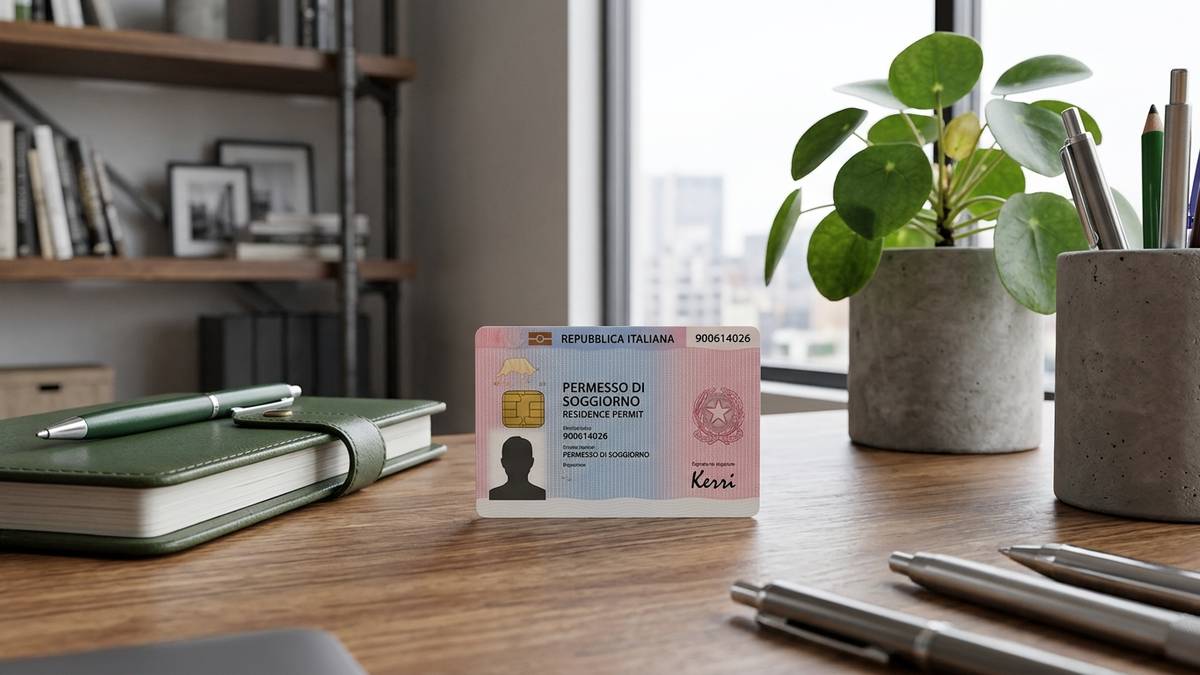
Entering Italy with a National Type D Elective Residence Visa marks the beginning of an intricate in-country administrative procedure rather than its conclusion. The visa affixed to your passport is legally classified as an entry clearance title; it does not confer autonomous residence rights on Italian soil. Under Italian immigration law, lawful residency commences only when an applicant formally applies for and obtains a residence permit (Permesso di Soggiorno per Residenza Elettiva).
In my practice representing international expatriates, I often see newly arrived individuals stumble over post-arrival administrative deadlines. Between the 8-day postal kit requirement, police biometrics appointments, civil municipal registration, and voluntary public healthcare enrollment, navigating Italian public offices demands procedural discipline. This guide outlines the exact statutory pathway required to secure and maintain your residence status in Italy.
Pre-Departure Preparation: Anticipated Italian Tax Code (Codice Fiscale)
Before boarding your flight to Italy, procedural due diligence begins with the procurement of your Italian Tax Code (Codice Fiscale).
The Codice Fiscale is the universal alphanumeric identifier issued by the Italian Revenue Agency (Agenzia delle Entrate). It is indispensable for every formal transaction in Italy: executing residential leases, registering utility contracts, purchasing property, opening bank accounts, and compiling the postal application kit.
While foreign nationals may apply for a Codice Fiscale upon arrival in Italy, doing so post-arrival creates avoidable bottlenecks. In my client onboarding protocol, I recommend procuring the official Codice Fiscale certificate prior to departure through the consular representation abroad or via legal power of attorney directly with an Italian tax office. This ensures your Italian tax identity is fully active before you land.
The 8-Day Postal Kit Protocol (Modello 209)
Article 11, paragraph 1 of Presidential Decree 394/1999 establishes an inflexible statutory obligation: foreign nationals entering Italy on a National Type D visa must formally submit their application for a residence permit within eight business days of arrival (entro otto giorni lavorativi dall’ingresso). Before departure, verify you meet the Elective Residence Visa requirements for 2026.
The application is filed through authorized branches of the Italian Post Office (Poste Italiane) equipped with an immigration window (Sportello Amico). The applicant must complete and submit the official postal dossier, known as the Kit Postale (specifically Modello 209, Comprensorio 1).
Mandatory Exhibits for the Postal Envelope
- Completed Modello 209 (Form 1);
- Complete photocopy of your passport (including biometric data pages, blank pages, and the original Italian Type D visa stamp);
- Photocopy of your registered Italian housing title (registered lease contract with Modello RLI or authentic deed of sale);
- Photocopy of your comprehensive private international health insurance policy;
- Certified copies of the passive income documentation presented to the consulate;
- Official payment receipts for statutory state taxes and postal administrative fees.
Statutory Administrative Costs (Separate from Legal Fees)
To maintain financial transparency, applicants should note that the following administrative costs are mandated by Italian law and payable directly to the Post Office and Ministry of Economy:
| Fee Category | Statutory Reference | Standard Amount | Payment Channel |
|---|---|---|---|
| Postal Service Fee | Ministerial Convention | €30.00 | Paid at Post Office counter |
| Electronic Smart Card Production | Decree Ministry of Economy | €30.46 | Postal payment slip (Bollettino) |
| Duty Stamp (Marca da Bollo) | D.P.R. 642/1972 | €16.00 | Purchased at authorized tobacco shop (Tabacchi) |
| Government Residence Contribution | Art. 5 co. 2-ter T.U.I. | €40.00 (up to 1 year) / €50.00 (over 1 year) | Postal payment slip (Bollettino) |
The Legal Status of the Postal Receipt (Cedolino) & Strict Travel Limits
Upon submitting the postal kit, the postal clerk hands you the official registered postal receipt (ricevuta postale or cedolino), displaying a tracking user ID and password.
Under Ministry of the Interior Circulars of 7 August 2007 and 11 March 2009, the postal receipt constitutes formal proof of your lawful pending stay on Italian territory. It allows you to reside lawfully in Italy while awaiting your biometrics appointment, access basic emergency healthcare services, and initiate municipal residency applications in municipalities whose local regulations accept pending status.
The Schengen Travel Barrier: Strict Travel Limitations
A pervasive and dangerous myth claims that the postal receipt functions as an international travel document across the European Union.
It does not. Under Regulation (EU) 2016/399 (the Schengen Borders Code) and Italian Ministry of Interior directives, the postal receipt issued for a first residence permit application (primo rilascio) does not authorize free transit through other Schengen Member States.
| Travel Scenario | Legal Feasibility | Regulatory Basis |
|---|---|---|
| Internal travel within Italy | Permitted without limitation | Circular Min. Interno 11/03/2009 |
| Direct transit to home country (Non-Stop) | Permitted (Direct flights only) | Circular Min. Interno 07/08/2007 |
| Transit / Layover in another Schengen Country | Strictly Prohibited (High Risk of Denial/Expulsion) | Schengen Borders Code (Reg. UE 2016/399) |
| Tourism in neighboring EU nations (e.g., France, Switzerland) | Strictly Prohibited | Non-recognition of Italian temporary receipts |
If you must exit Italy while your first permit application is pending, you must fly directly between an Italian international airport and your non-Schengen country of destination without layovers in other Schengen nations. Transiting through airports such as Frankfurt, Paris, or Zurich on a first-application postal receipt can result in entry denial, administrative detention, and formal border expulsion.
Schedule a Post-Arrival Procedural Review
Managing post-arrival administrative compliance requires strict adherence to Italian immigration statutes. If you have recently arrived in Italy or need assistance preparing your 8-day postal kit, managing Questura communications, and organizing municipal registration, schedule an individual legal consultation. During this session, I will audit your entry documentation, review your postal filing package, and establish a compliant establishment roadmap.
Fee: €250 all-in total (taxes included) — 100% credited toward the subsequent legal fee if you retain my firm for further assistance, pursuant to D.M. 55/2014.
Questura Biometrics (Fotosegnalamento) & Integration Agreement
Along with your postal receipt, the Post Office issues a printed appointment notice specifying the date, time, and address of your biometrics appointment (fotosegnalamento) at the territorial Immigration Office of the Questura.
At the Questura appointment, you must appear in person to undergo digital fingerprinting and photographic identification, presenting your original passport containing the Type D visa, original registered postal receipt, four passport-sized photos, original housing title, and certified income evidence.
The Integration Agreement (Accordo di Integrazione)
Pursuant to Article 4-bis of the Immigration Act (D.Lgs. 286/1998) and Presidential Decree 179/2011, foreign nationals over the age of 16 entering Italy for the first time on a permit of at least one year must execute an Integration Agreement (Accordo di Integrazione) with the Italian State. Under this agreement, the applicant commits to acquiring spoken knowledge of Italian (level A2), attaining understanding of Italian civic principles, and ensuring minor children complete compulsory schooling. For a compliant roadmap, schedule a procedural review consultation.
Municipal Residency (Iscrizione Anagrafica) vs. Residence Permit
A fundamental procedural distinction in Italian administrative law is the separation between your Immigration Title (the Permesso di Soggiorno issued by the Ministry of the Interior via the Questura) and your Civil Residency (the Iscrizione Anagrafica registered with the local Municipal Civil Registry / Comune).
Under Article 6, paragraph 7 of D.Lgs. 286/1998 and D.P.R. 223/1989 (Anagrafe Regulations), foreign nationals lawfully residing in Italy must register their habitual abode (dimora abituale) with the civil registry of the municipality where they reside.
- Filing the Declaration: The applicant submits the formal declaration of residence (Dichiarazione di Residenza) to the Municipal Registry, attaching proof of lawful stay, housing title, and Codice Fiscale.
- The 45-Day Police Inspection Window: Following submission, municipal registry officials record a provisional registration. Under Article 19 of Law 35/2012, local municipal police officers (Vigili Urbani) have a statutory window of 45 calendar days to conduct unannounced on-site physical inspections at the dwelling to verify that you are genuinely living there.
- Definitive Confirmation: If the police confirm habitual presence, or if the 45-day window lapses without an adverse determination, the residency registration becomes permanent with retroactive legal effect to the initial date of declaration.
Healthcare Coverage: Private International Insurance vs. Voluntary SSN Enrollment
Maintaining valid healthcare coverage is an ongoing legal condition of your elective residence status. Under Article 34 of D.Lgs. 286/1998 and the State-Regions Agreement of 20 December 2012, elective residents are not entitled to mandatory free enrollment in the Italian National Health Service (SSN).
| Healthcare Dimension | International Private Health Policy | Voluntary SSN Enrollment (Iscrizione Volontaria) |
|---|---|---|
| Statutory Basis | D.I. 11/05/2011; Consular Mandate | Art. 34 T.U.I.; L. 213/2023 (Budget Law 2024) |
| Annual Financial Cost | Market premium based on age, coverage limits, and deductible | Calculated as percentage of global income; statutory minimum of €2,000 annually |
| Temporal Coverage Period | 365 days from policy effective date | Strictly calendar year (1 January to 31 December); zero proration |
| Territorial Scope | Comprehensive coverage across Italy and internationally | Full integration into Italian public health system, GP assignment, public hospitals |
| Consular Visa Validity | Mandatory for Visa Issuance Abroad | Inadmissible abroad; only accessible post-arrival following municipal registration |
| Pre-Existing Conditions | Frequently excluded or subject to underwriting loading | Covered unconditionally under public health parameters |
Under Law 213/2023 (effective 1 January 2024), the Italian Parliament reformed voluntary health enrollment, establishing an absolute minimum annual contribution of €2,000 per calendar year. The contribution cannot be prorated. If you enroll in October, you pay the full statutory contribution for coverage expiring on 31 December.
Statutory Absence Limits ex Art. 13 D.P.R. 394/1999 & The Absence Log
A critical legal trap that jeopardizes future permit renewals and long-term settlement is the violation of statutory absence limitations. Article 13, paragraph 4 of Presidential Decree 394/1999 establishes precise mathematical limits regarding physical absence from Italian territory:
- Annual Permit (1 Year Duration): Continuous uninterrupted absence exceeding 6 MONTHS creates a statutory bar to renewal.
- Multi-Year Permit (2 Years or More): Continuous uninterrupted absence exceeding HALF THE DURATION creates a statutory bar to renewal.
In my practice, I instruct clients to maintain an audited Absence Log (Registro delle Assenze), recording exact departure and return dates, border crossings, boarding passes, and documentation of force majeure events (such as medical emergencies) that lawfully suspend absence limitations.
The Long-Term Horizon: Renewals, 5-Year EU Permanent Residency & Tax Realities
The initial elective residence permit is typically issued for a duration of one year. The renewal application must be submitted through the Post Office at least 60 days prior to expiration. At the renewal stage, the Questura requires updated proof of continuous passive income, valid health coverage, and evidence of unbroken residence.
The 5-Year EU Long-Term Residence Permit (Carta di Soggiorno)
After five years of continuous and lawful residence, an elective resident may apply for the Permesso di Soggiorno UE per Soggiornanti di Lungo Periodo under Article 9 of D.Lgs. 286/1998. This title provides permanent residence status, eliminates annual renewal friction, and requires continuous lawful residence for 5 years (total cumulative absences not exceeding 10 months across the 5-year period), stable income not lower than the social allowance, and an A2 Italian language certification.
Italian Tax Residency under Reformed Art. 2 TUIR
Under Article 2 of Presidential Decree 917/1986 (TUIR), as reformed by Legislative Decree 27 December 2023, n. 209, an individual is deemed an Italian tax resident if, for at least 183 days of the calendar year, they have registration in the Civil Registry (Anagrafe), domicile in Italy, or physical presence on the territory of the State. Postponing municipal registration does not shield an individual who is physically present in Italy from tax residency.
Frequently Asked Questions
Can I travel outside Italy while waiting for my first residence permit?
Only under strict conditions. You may travel directly between Italy and your home country (non-stop flights) using your passport and the official postal receipt (cedolino). You are strictly prohibited from transiting through other Schengen countries (e.g., layovers in Paris, Frankfurt, or Amsterdam) or traveling as a tourist in other EU nations, as temporary Italian receipts are not recognized under the Schengen Borders Code.
How long does it take for the Questura to issue the physical electronic residence permit?
Processing times vary widely by province. Under Article 5, paragraph 9 of D.Lgs. 286/1998, the statutory processing deadline is 60 days. In reality, metropolitan police headquarters frequently take between four and eight months. During this waiting period, your lawful residence is fully protected by your official postal receipt. If delays become excessive, judicial remedies against administrative silence under Articles 31 and 117 C.P.A. may be evaluated.
What happens if the municipal police visit my home while I am temporarily away?
If the local police (Vigili Urbani) inspect your home and find you absent, they typically leave a formal notice requesting that you appear at the municipal police station with your lease contract and identification. If multiple unannounced visits reveal no sign of habitation, the municipality will reject your registration application for lack of habitual abode.
Can an Elective Residence Permit be converted into a Work Permit in Italy?
Under ordinary circumstances, no. An elective residence permit cannot be converted into an employment or self-employment permit within Italy. If an elective resident decides to enter the Italian labor market, they must qualify under statutory quota systems (Decreto Flussi) or specific extra-quota categories (such as the EU Blue Card or Digital Nomad Visa), which generally require applying for a new entry visa from abroad.
Book Your Preliminary Legal Consultation
Ensure your post-arrival establishment in Italy complies with every statutory mandate.
Fee: €250 all-in total (taxes included) — 100% credited toward the subsequent legal fee if you retain my firm for further assistance, pursuant to D.M. 55/2014.
Moving to Italy on an Elective Residence Visa? What to Audit Before Signing Leases or Applying
Download my Italian Elective Residence Visa Protocol & Self-Assessment Guide to verify your passive income compliance, assess consular district standards, navigate the 8-day Permesso di Soggiorno postal kit, and avoid the informal withdrawal trap before committing capital.