

Circolare Italian Citizenship Minor Issue: How to Tackle It
🚨 DEFINITIVE 2026 UPDATE: Circular 43347/2024 Has Been Officially Revoked by Circular Prot. 65050/2026
Read this first: Following the landmark rulings of the United Sections of the Italian Supreme Court of Cassation (Decisions No. 24045/2026 and No. 24184/2026), which ruled that children born in ius soli countries retained Italian citizenship under Article 7 of Law No. 555/1912 despite a parent’s naturalization during their minority, the Ministry of the Interior issued Circular Prot. 65050 on August 10, 2026. Circular 65050/2026 formally revoked Circular 43347/2024 on the Minor Issue and instructed consulates and municipalities to re-examine previously rejected or suspended pre-reform applications in mandatory self-review (autotutela doverosa).
Executive Summary: Issued on October 3, 2024, Ministry of the Interior Circular No. 43347/2024 instructed Italian municipalities and consulates to reject iure sanguinis applications whenever an Italian ancestor naturalized abroad while the next-in-line child born in a ius soli country was still a minor (Article 12(2) of Law No. 555/1912). In July–August 2026, that administrative directive was overturned by Supreme Court United Sections Rulings No. 24045/2026 and No. 24184/2026 and formally revoked by Ministry of the Interior Circular Prot. 65050 of August 10, 2026. Below I explain how to reopen rejected or suspended pre-March 27, 2025 consular files through a 30-day certified PEC legal notice (Article 48 CAD) without falling into secondary 10-day pre-rejection traps (Article 10-bis of Law No. 241/1990), how post-March 27, 2025 claims are litigated under Law No. 74/2025 and Constitutional Court Order No. 147/2026, and why Sections 2 and 3 of Circular 43347/2024 (on out-of-wedlock filiation and possession of status under Article 237 c.c.) remain relevant in historical archival reconstructions—followed by the full archival English translation of Circular 43347/2024.
1. From Circular 43347/2024 to Circular Prot. 65050/2026: What Changed?
When the Ministry of the Interior issued Circular No. 43347 on October 3, 2024, it relied on a restrictive interpretation from the First Civil Section of the Court of Cassation (Orders No. 17161/2023 and No. 454/2024) to subordinate Article 7 of Law No. 555/1912 (which protected original dual citizens born in ius soli countries) to Article 12, paragraph 2 (which governed the loss of citizenship for minor children of naturalizing parents).
In July 2026, the Civil United Sections of the Supreme Court of Cassation (Decisions No. 24045/2026, No. 24184/2026) overruled that restrictive line of cases. The Joint Bench established that a child born in a ius soli country (such as the US, Canada, Brazil, or Argentina) to an Italian citizen parent acquired both citizenships at birth (bipolide ab origine) and retained Italian citizenship under Article 7 of Law No. 555/1912 even if the father or mother subsequently naturalized abroad during the child’s minority. Article 12(2) applies exclusively to minors who held only Italian citizenship at birth and acquired foreign citizenship derivatively.
Forced to align administrative practice with the Supreme Court’s nomofilactic precedent, on August 10, 2026 the Ministry of the Interior issued Circular Prot. 65050/2026, which expressly revoked Point 1 of Circular 43347/2024 and authorized consulates and municipalities to re-examine rejected or suspended Minor Issue files in self-review (autotutela).
2. How to Tackle Pre-March 27, 2025 Consular Rejections or Suspensions Today
If your application was submitted (or backed by an appointment communicated) on or before March 27, 2025 and was rejected or placed on hold due to Circular 43347/2024, your case is exempt from the generational caps of Law No. 74/2025. However, requesting a consular re-examination requires navigating three procedural traps:
- Formal Rejections vs. “Virgin Files” (The Toronto Consulate Warning): Where a consulate previously issued a formal rejection solely on the Minor Issue, procedural estoppel (the prohibition against venire contra factum proprium) restricts the scope of re-examination. Conversely, where a consulate merely suspended the file without completing a vital-records audit (“virgin files,” as highlighted in the Consulate General in Toronto’s official notice of August 13, 2026), reopening the dossier triggers a strict line-by-line inspection of all birth, marriage, and naturalization certificates.
- The 10-Day Pre-Rejection Trap (Article 10-bis of Law No. 241/1990): If the consular officer uncovers name anglicizations, date discrepancies, or missing long-form certificates upon reopening your file, the office issues a formal Article 10-bis Pre-Rejection Notice granting a peremptory 10-calendar-day deadline to submit defensive briefs—far too short to obtain foreign court amendments.
- Why a 30-Day Certified PEC Legal Notice (Article 48 CAD) Is Essential: Sending an informal ordinary email request does not place the Administration in legal default and exposes the applicant to 24-to-36-month waiting queues without status updates. Because re-examination under Circular Prot. 65050/2026 is a mandatory act of self-review (autotutela doverosa) to remove an unlawful act, the consulate cannot lawfully invoke a new 730-day processing term. In my practice, I first audit your entire vital-records chain to reconcile any historical discrepancies, and then serve a formal legal brief via Certified Electronic Mail (PEC under Article 48 of Legislative Decree No. 82/2005 – CAD) with a strict 30-day compliance notice (diffida ad adempiere).
3. Exclusive Jurisdiction of the Ordinary Civil Court (Not the TAR) and the 26 District Courts
A crucial procedural rule must be clarified regarding judicial appeals against consular or municipal denials of citizenship by descent:
- Ordinary Civil Court vs. Administrative Court (TAR): Because Italian citizenship iure sanguinis is a permanent, imprescriptible fundamental subjective right (diritto soggettivo perfetto, Cass. SSUU No. 4466/2009 and No. 24045/2026), jurisdiction over the recognition of citizenship belongs exclusively to the Ordinary Civil Judge (Tribunale Civile Ordinario)—never to the Regional Administrative Court (TAR), which only adjudicates discretionary concessions such as residency or marriage naturalizations. Consequently, a consular denial is not subject to the 60-day TAR forfeiture window: it is challenged through a simplified civil action under Article 281-decies of the Code of Civil Procedure (or under Article 95 of D.P.R. 396/2000 if challenging a municipal registrar’s refusal in Italy).
- Mandatory Territorial Venue Across the 26 District Courts (Law No. 206/2021): For applicants residing abroad, Article 4, paragraph 5, of Legislative Decree No. 150/2011 (as reformed by Law No. 206/2021) assigns mandatory territorial jurisdiction to the Specialized Immigration Section of the Tribunal located in the capital of the Court of Appeal District covering the Italian ancestor’s municipality of birth (one of the 26 District Courts in Italy, not the 165 ordinary municipal courts). Tactical note on the Court of Naples: Under Article 16 of Decree-Law No. 100/2026, the special backlog section (Ufficio per il Processo Stralcio) at the Court of Naples handles exclusively cases filed on or before June 11, 2026; all petitions filed after that date are assigned to the career judges of the 13th Civil Section.
4. Post-March 27, 2025 Claims: Law No. 74/2025 and the Multilevel Defensive Pyramid
For applicants who had not filed an administrative application or judicial petition by March 27, 2025, overcoming the Minor Issue under SSUU 24045/2026 secures Level 1 (historical lineage validity), while Level 2 (current admissibility) is governed by Article 3-bis of Law No. 91/1992 (introduced by Law No. 74/2025) and Ministry of the Interior Circular No. 26185 of May 29, 2025. In judicial proceedings before the 26 District Courts, I structure post-cutoff cases through my Multilevel Defensive Pyramid:
- Level 1 (Constitutionally Conforming Interpretation of Art. 3-bis, lett. c): Interpreting the requirement that a 1st- or 2nd-degree ascendant held “exclusively” Italian citizenship (verified at the descendant’s birth under Circular 26185/2025) as absence of voluntary foreign naturalization, harmonizing Article 3-bis(c) with the protected status of original dual citizens affirmed in SSUU 24045/2026.
- Level 2 (EU Law Stay Under Constitutional Court Order No. 147/2026): Requesting a stay of proceedings under Article 267 TFEU pending the Court of Justice of the European Union’s ruling on Order No. 147/2026 (Articles 9 TEU and 20 TFEU).
- Level 3 (Constitutional Challenge to Letter c as a “Virgin Question” — Point 9.2 of Order No. 147/2026): Raising the unconstitutionality of Article 3-bis(1)(c) under Articles 3 and 117(1) of the Constitution (Article 8 ECHR), expressly certified as an unexamined (“virgin”) constitutional question in Point 9.2 of Order No. 147/2026.
- Parallel Track (Blameless Impediment — Point 9.1 of Judgment No. 63/2026): Invoking legitimate expectation where the applicant was prevented from filing before March 27, 2025 due to Prenot@Mi booking freezes or reliance on the unlawful Circular 43347/2024.
5. Archival Reference: Full English Translation & PDFs of Circular No. 43347/2024
Historical Note: While Section 1 of Circular No. 43347/2024 (on the Minor Issue) was declared unlawful by Cass. SSUU No. 24045/2026 and revoked by Circular Prot. 65050/2026, Sections 2 and 3 below—concerning the retroactive effect to birth of adult filiation recognition (Cass. No. 5518/2024) and judicial proof of continuous possession of child status in the absence of a birth certificate under Article 237 of the Civil Code (Cass. No. 14194/2024)—remain useful reference points.
SUBJECT: Recognition of Italian Citizenship Iure Sanguinis – New Lines of Interpretation Dictated by Recent Decisions of the Supreme Court (October 3, 2024, Prot. 43347 — Section 1 Revoked on August 10, 2026)
In relation to the procedure for the recognition of Italian citizenship iure sanguinis, it is deemed appropriate to present the new interpretative lines dictated by recent rulings of the Supreme Court of Cassation. This is also in light of numerous queries received on the subject from Prefectures as well as directly from municipalities.
1. Relationship between Article 7 and Article 12 of Law No. 555 of 1912 [REVOKED BY CIRCULAR PROT. 65050/2026]
As is well known, certain provisions of the former Law No. 555/1912, although repealed, are still relevant today for clarifying the fate of citizenship that occurred prior to the enactment of Law No. 91/1992. This is to ascertain whether it is possible to recognize Italian citizenship based on the uninterrupted transmission of the same to descendants of Italian citizens claiming our status civitatis.
In particular, the problem concerns the relationship between Article 7 of Law No. 555/1912 (regulating cases of dual citizenship for those born in countries granting citizenship iure soli) and Article 12, second paragraph, of the same law. The latter provides: “Unemancipated minor children of those who lose their citizenship shall become aliens, when they have common residence with the parent exercising parental authority or legal guardianship, and acquire the citizenship of a foreign state. However, the provisions of Articles 3 and 9 shall be applicable to them.”
In this regard, new lines of interpretation have recently emerged from the Supreme Court of Cassation (Cass. civ. Sec. I, Ord., no. 454/2024 and no. 17161/2023). These rulings pertain to appeals brought by foreign citizens seeking recognition of their status civitatis by virtue of alleged descent from Italian ancestors.
In the cases in question, the ancestor lost Italian citizenship by choosing to naturalize as a foreign citizen. Consequently, the son (who was a minor at the time) simultaneously acquired Italian citizenship iure sanguinis by paternal derivation and foreign citizenship iure soli. However, the son did not express the will to reacquire Italian citizenship pursuant to Article 12 of Law No. 555/1912, as the other conditions set forth in Article 9 of the same law do not apply.
The Supreme Council stated: “Ultimately, Law no. 555/1912 recognizes dual citizenship in the following terms: a son of an Italian citizen born abroad could simultaneously acquire Italian citizenship iure sanguinis and the citizenship of the place of birth iure soli, and in that case, he was entitled to retain dual citizenship, remaining to all intents and purposes an Italian citizen, unless he renounced it as an adult. Unless – while he was underage – the cohabiting father lost his Italian citizenship, and specifically, in the case of naturalization, by an act of voluntary impulse, that is, by reason of a decision which, insofar as it was adopted by the ‘head of the family’ holder of parental authority, also produced effects in the legal sphere of the children to minors subject to him. This is the only possible interpretation of the normative text, because of the literal criterion, but also having regard to its ratio legis, since it is clearly aimed at preserving the unity of citizenship within the same family, in the terms in which it was understood in both 1865 and 1912, namely, as a community in which there was identifiable a ‘head of the family’ who had parental authority over minors, assumed responsibility for protecting the minus habens (wife and children) and made decisions that bound everyone; and provided that the family unit was effective, by reason of common residence.” (Cass. civ. Sec. I, Ord., No. 454/2024).
It follows, therefore, that following the voluntary naturalization (during the minor age of the dual citizen at birth) of the parent cohabiting with him or her, the lines of transmission are to be considered interrupted where the ascendant in question has not reacquired Italian citizenship once he or she comes of age. In such cases, failure to regain Italian citizenship prevents the ability to transmit our status civitatis to one’s line of descendants.
To promptly adjust administrative action to the aforementioned clear jurisprudential indications, it is believed that, within the framework of the analysis of applications for iure sanguinis citizenship, the new orientation and the consequent lines of interpretation can be taken into account as of now.
Therefore, during the preliminary analysis of applications for citizenship iure sanguinis potentially affected by the interruptive event in question, the applicant must produce evidence of the reacquisition of Italian citizenship by the ancestor who lost Italian citizenship as a minor due to the voluntary naturalization of the parent, even if he or she already held foreign citizenship for having been born in a country where the criterion for the granting of citizenship iure soli is in force.
The “non-naturalization” document, issued by the competent Authorities of the foreign State of emigration (with an official translation into Italian language as per point 5) of Circular K.28.1/1991) must therefore certify that the Italian ancestor who emigrated from Italy did not voluntarily acquire the citizenship of the foreign State of emigration. Conversely, if the ancestor voluntarily acquired foreign citizenship, the document will have to certify the date of his or her naturalization in order to ascertain that the naturalization itself occurred during the descendant’s minor age (and no longer only prior to the descendant’s birth).
In case there is a loss of Italian citizenship under Article 12, second paragraph, of Law No. 555/1912 of one of the ascendants of the claimant of Italian status civitatis, in order to be able to recognize this status it will be necessary for the claimant to produce the documentation proving the reacquisition of Italian citizenship in accordance with Articles 3 or 9 of Law No. 555/1912 at the Civil Status Offices in Italy or abroad of the place to which the ascendant transferred his or her residence, provided that the reacquisition of Italian citizenship by the ascendant occurred before the birth of his or her descendants in the direct line. However, rights already acquired by third parties are not affected.
2. Effective date of acquisition of citizenship by those who have been recognized by an Italian citizen or whose filiation has been judicially declared in the course of their majority.
Regarding the effective date of acquisition of Italian citizenship for one who is recognized or judicially declared the child of an Italian parent during the age of majority and has made, within the terms of legislation, the election of Italian citizenship, this hypothesis is regulated by Article 2, paragraph 2, of Law No. 91/1992. On this point, the Supreme Court in Decision No. 5518/2024 relied on the equality of status between children recognized at birth and those recognized after reaching majority, holding that Article 2, paragraph 2, introduces a potestative condition precedent which, once fulfilled, produces acquisition of Italian citizenship retroactive to birth, thus transmitting status to any descendants.
3. Uninterrupted possession of child status (Article 237 Civil Code).
Finally, in Judgment No. 14194 of May 22, 2024, the Court of Cassation clarified that where a birth certificate of the Italian ancestor is missing or defective, paternity and filiation may be established in judicial proceedings through continuous possession of child status under Articles 236(2) and 237 of the Italian Civil Code (such as posthumous recognition recorded in a marriage act), enforceable before the ordinary civil courts.
📄 Archival PDF Downloads: Download English PDF Translation | Download Original Italian Circular 43347/2024 (PDF)
Historical Context of Circular 43347/2024 & Video Walkthrough
Read this first. The Ministry of the Interior Circular 43347/2024 on the so-called minor issue no longer reflects the prevailing case law. The Supreme Court of Cassation, United Sections, has redefined the framework: see our full analysis of the minor issue Italian citizenship Supreme Court ruling 24045/2026 before rel…
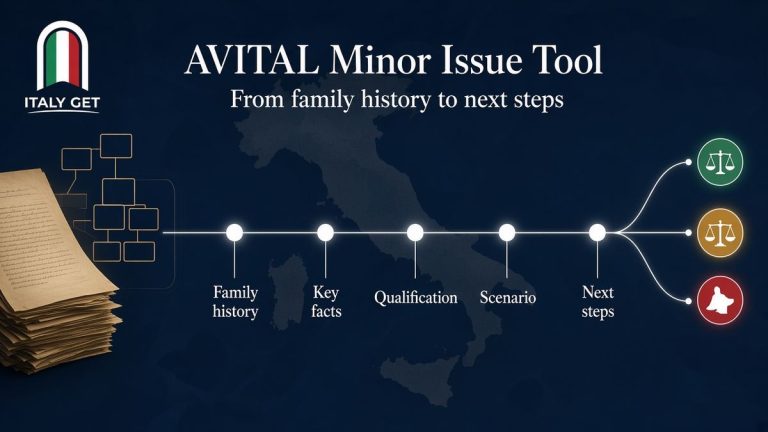
Following the landmark Supreme Court ruling ( Sezioni Unite No. 24045/2026 ) and the official Ministry of the Interior Circular Prot. 65050 (August 10, 2026) , I have upgraded our diagnostic engine to Version 2.4 to provide immediate, actionable procedural guidance for applicants worldwide.
- Consular Re-Examination ( Istanza di Riesame ): Step-by-step triage for applications/appointments submitted before March 27, 2025 to request a direct administrative review without filing a new petition or paying additional consular fees.
- Law 74/2025 Safeguard Matrix: Precise classification between cases protected under Article 3-bis exceptions (1st/2nd degree direct lines or parental residence) and those requiring court proceedings supported by the EU Court of Justice referral ( Order 147/2026 ).
- Historical Age Engine: Automated calculation of the historical age of majority (21 years before March 10, 1975 vs 18 years thereafter) to identify authentic vs false minor issue cases.
The new Circolare Italian Citizenship with Minor Issue, dated October 3rd, n° 43347 by Ministero dell’Interno, threatens all future (and, possibly) pending applications for citizenship with a “minor issue” filed in Italian town halls.
Fortunately, completed applications are not affected as the circolare explicitly excludes them.
I believe that this Circolare is probably illegitimate and will lead to even more appeals, something that the Italian Ministero certainly did not expect to cause!
It is anticipated that a new ruling will be forthcoming soon, which will address the question of the proper application of Articles 7 and 12 of Law 555 of 1912 to cases of children born abroad in a jus soli case whose parent became naturalised during their minority. I’ll keep you posted on this blog and on my youtube c…
- an easy-to-read guide to the new legal challenges posed by the Circolare.
Italian Citizenship Minor Issue: Recent Changes and Solutions
Obtaining Italian citizenship jure sanguinis is a dream for many, but recent legal developments have complicated the process, especially for those facing the so-called “minor issue.”
It was previously believed that a child born in a jus soli country, such as the United States, retained Italian citizenship even if their parent acquired American citizenship while they were still a minor. However, a new “circolare” from the Ministry of the Interior has changed this interpretation, giving greater weigh…
This circular, while not a law, has a strong impact on people’s lives, influencing how Italian municipalities interpret the citizenship law. Its issuance was influenced by recent rulings of the Supreme Court of Cassation, which favored Article 12 over Article 7, which guaranteed the retention of Italian citizenship unt…
Possible Solutions for Italian Citizenship Minor Issue
Despite this change, there is still hope. There are still possible solutions for those who wish to obtain Italian citizenship:
- 1948 Case: One can claim citizenship through the maternal line, taking advantage of the 1948 law that recognizes the equal rights of mother and father in the transmission of citizenship.
- Marriage Loophole: Another possibility is the so-called “marriage loophole”, which considers emancipated a person married before the age of 21 and before the naturalisation of the parents. However, this last option does not yet have a solid legal basis.
- Challenging the refusal through an administrative appeal : If the municipality (or the consulate) decides to reject an application, the applicant must receive a “notice of rejection”, which indicates the administration’s intention not to grant citizenship. At this point, the applicant has 10 days to submit a defence in…
- Apply by judicial petition: Those who can no longer apply to a consulate or town hall because of this new Circolare, now have the option (which wasn’t generally available before) of applying through the Italian judicial system. In fact, while Italian consulates and municipalities will strictly apply the new interpretat…
Despite the uncertainty generated by the circular, so far most judicial appeals concerning the minor issue have been accepted by the Italian regional courts.
Out of the 165 Italian local courts (tribunali ordinari) in only 5 rejection of minor issue cases have been reported (namely Rome, Messina, Palermo, L’Aquila, Ancona).
The possibility of applying to the Italian courts, before the Circolare, was open only in two other scenarios: when the waiting time at the consulates exceeds 730 days, and in cases where a female ancestor gave birth to her offspring before 1948. This route, which involves some procedural complexities, shows positive r…
Other kind of legal cases, like those involving women who lost their Italian citizenship due to their husband’s naturalization before 1922 (pre-Cable Act), or cases where the Italian ancestor never naturalized or did so after the child’s majority, will not be impacted whatsoever by the circolare 43347 and have the same…
It is important to emphasize that the issue of circulars is a broader problem in the Italian legal system . These documents, used in various areas (lately, especially during the COVID crisis), aim to clarify the interpretation of laws, but some legal experts argue that this practice may undermine transparency and legal…
Therefore, if you have a pending case or are thinking of filing an appeal for Italian citizenship, don’t panic and move on. The path to obtaining Italian citizenship can be complex, but not impossible. It is essential to rely on an expert in Italian citizenship law who can guide you through the intricate laws and recen…
What is the minor issue in Italian citizenship?
The minor issue refers to the recent interpretation that a child may lose their Italian citizenship if their parent naturalizes in another country while the child is still a minor, even if born in a jus soli country.
Can I still claim Italian citizenship if affected by the minor issue?
Yes, there are still potential solutions, such as claiming citizenship through the 1948 case or exploring other legal avenues.
As an additional route, it is always possible to challenge the town hall) or consulate rejections. It’s best to consult with an expert in Italian citizenship law for your specific case.
The new circular has made it more challenging for some individuals to claim Italian citizenship, particularly those affected by the minor issue. However, most courts are still approving cases related to this issue.
Regarding the effective date of acquisition of Italian citizenship for one who is recognized or judicially declared the child of a parent of Italian during the age of majority and has made, within the terms of legislation, the election of Italian citizenship, the following should be represented.
As is well known, this hypothesis of the acquisition of citizenship, hitherto counted among those by way of derivation, is currently regulated by Article 2, paragraph 2, of Law No. 91/1992.
In the silence of the law, the acquisition of Italian citizenship in such cases has always been understood as taking effect from the day following the manifestation of the interested party’s willingness to become an Italian citizen, considering applicable, also to the aforementioned cases, art. 15 of Law n. 91/1992, ac…
On this point, the Supreme Court in Decision No. 5518/2024 came to a different interpretation, relying on the absolute equality of the status of children recognized at the time of birth and those who become so after reaching the age of majority.
More specifically, the Court had occasion to specify that: “An adult or recognized or declared child of an Italian citizen does not acquire a different status from that of the child of an Italian citizen duly married and born in constancy of marriage. He is Italian because he is the child of an Italian citizen iure san…
Therefore, the act of election, rather than having a constitutive character in the matter of the acquisition of citizenship, has the function of protecting the self-determination of the individual, who could decide whether or not to be invested with our status civitatis as a result of the recognition of filiation.
Henceforth, therefore, the aforementioned act of election—which obviously remains a condition for the attribution of citizenship iure sanguinis in these cases—shall no longer be taken as a reference for the purposes of the starting date of the acquisition of Italian citizenship, having rather to consider that said acqu…
In light of the above, it is therefore necessary to specify that for the purpose of reconstructing the line of transmission of citizenship iure sanguinis, in all cases of filiation out of wedlock, the deed or judicial declaration of recognition of the filiation relationship between the interested party or ascendant and…
Finally, it is considered appropriate to clarify the scope of application of the principles enunciated by the Court of Cassation in Judgment No. 14194 of May 22, 2024 regarding a iure sanguinis case that had been rejected by the civil status office due to the inability of the petitioners to produce a birth certificate …
The Supreme Court has made it clear that it is possible to make up for the lack of and/or defect in the birth certificate or related indications of paternity and maternity in it through Article 237 of the Civil Code, according to which: “The possession of status results from a series of facts which together serve to pr…
As is well known, this rule can be applied only as a subsidiary to Article 236, first paragraph, of the Civil Code, in the mind of which filiation is proved by the birth certificate entered in the civil status registers; pursuant to the second paragraph of the same article, only in the absence of the birth certificate …
In any case, the opinion is expressed that the application of this provision does not appear to be extensible to proceedings of an administrative nature as well, since the administrative authority is not responsible for the substantive recognition of the status civitatis personae (the responsibility of the ordinary jud…
In light of the above, it is believed that this principle can only be enforced in the courts.
SS.LL. is requested to represent the above to the mayors and registrars of municipalities in their respective provinces in order to bring administrative action in line with the most recent guidelines of the Supreme Court.
A minor issue notation — whether recorded at birth, marriage, or in the maternal line — does not automatically close the door to Italian citizenship. The legal landscape changed significantly after the Supreme Court’s 2024-2025 rulings on legitimate expectation. If you received a pre-rejection notice citing a minor iss…
For a broader overview of how the 1912 naturalization rules interact with recent parliament updates, consult our guide on the Italy citizenship law change 2025 .
If a first-instance court issued a negative ruling based on the 1912 minor issue, you can appeal a court denial for Italian citizenship before the Corte d’Appello.
Frequently Asked Questions (FAQ)
Is Ministry Circular 43347/2024 still in force for the Minor Issue?
No. Following Supreme Court United Sections Rulings No. 24045/2026 and No. 24184/2026, the Ministry of the Interior issued Circular Prot. 65050 on August 10, 2026, revoking Circular 43347/2024 on the Minor Issue and authorizing the re-examination in self-review (autotutela) of rejected or suspended pre-reform applications.
Which court has jurisdiction if a consulate or municipality rejects my citizenship application?
Because citizenship by descent is a permanent subjective right, exclusive jurisdiction belongs to the Ordinary Civil Court (not the Regional Administrative Court / TAR). Claims by applicants residing abroad are filed before the Specialized Immigration Section of the competent District Court (1 of 26 appellate district capitals under Law No. 206/2021) pursuant to Article 281-decies c.p.c., while municipal refusals in Italy are challenged under Article 95 of D.P.R. 396/2000.
Why should I use a 30-day certified PEC notice to reopen my consular file under Circular 65050/2026?
A formal legal brief notified via Certified Electronic Mail (PEC under Article 48 CAD) with a 30-day compliance deadline places the consulate in legal default, prevents indefinite 24–36 month waiting queues, and shields your file against sudden 10-day pre-rejection notices (Article 10-bis of Law No. 241/1990) over secondary vital-record discrepancies.
Need an Italian Citizenship Attorney for a Minor Issue Re-Examination or Judicial Appeal?
Whether your pre-March 27, 2025 application was rejected or suspended under old Circular 43347/2024 (requiring a pre-filing documentary audit and a 30-day PEC self-review notice under Circular Prot. 65050/2026), or you need to file a judicial petition before the competent Italian District Court (or appeal a first-instance court denial), I personally examine your lineage and naturalization records to define a realistic procedural strategy, subject to the prudent appreciation of the adjudicating Court.
Forensic Transparency Guarantee (D.M. 55/2014): 100% of the preliminary consultation fee is credited in full toward your legal representation retainer should you proceed with formal court or administrative proceedings within 90 days.

Avv. Michele Vitale
Attorney-at-Law admitted to the Bar Association of Larino (Italy). Law Firm: Via Ruffini 29/A, 86039 Termoli (CB), Italy — VAT ID 01876430701. Specialized in judicial litigation for the recognition of Italian citizenship iure sanguinis (1948 maternal line, consular delays under Law 241/90, defenses against Art. 10-bis rejection notices, and Supreme Court proceedings following Cassazione SSUU 24045/2026 and Law 74/2025). Bar admission publicly verifiable on the official registry of the Consiglio Nazionale Forense (CNF).